A Double Feature Built Around One Sound
Build a double feature around one recurring sound to hear how different films turn the same noise into suspense, comfort, distance, or dread.
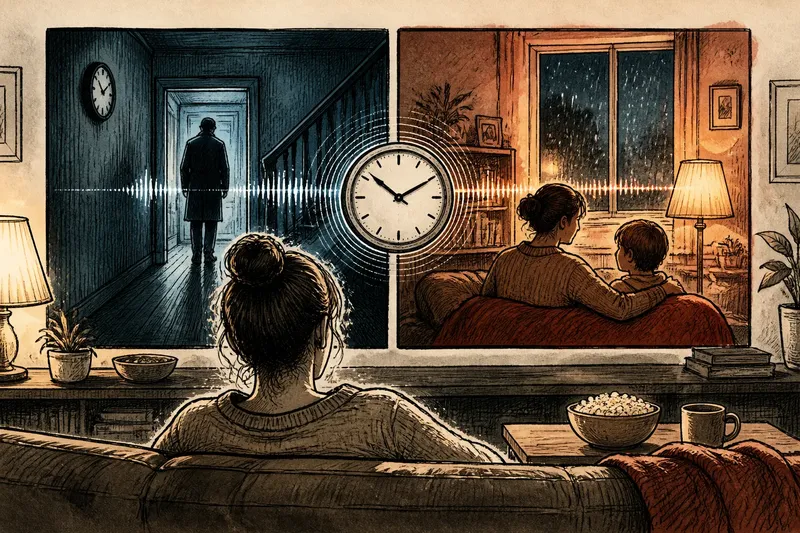
You settle onto the couch, start a film, and hear a clock ticking in an otherwise quiet room. Later in the week, another film gives you that same small sound—but it feels less like a warning than a welcome. A double feature built around one sound turns this shift into the evening’s central pleasure: listen for a recurring noise, then notice how two contrasting films make it mean different things.
The sound does not have to be a musical theme or a dramatic crash. It might be rain, footsteps, a doorbell, a dog barking, a train, or the hum of a refrigerator. The useful question is not simply, “Can I hear it?” It is, “What does this sound make me expect, and how does the film shape that expectation?”
Choose a sound that can carry more than one mood
Start with a sound that is recognizable but flexible. A bell can signal a visitor, a deadline, a school day, or a memory. Rain might soften a private conversation in one story and make a street feel exposed in another. A repeated footstep can suggest someone approaching, someone leaving, or a character trapped in a familiar routine.
Pick the sound before picking the films. That order keeps the pairing focused without requiring the movies to share a plot, genre, country, or era. Once you have a sound in mind, look for two films in which it recurs or matters to the atmosphere—not merely one title that happens to contain a single incidental instance.
Some sounds are easy to spot in descriptions and clips. Others are best chosen from films you already know. If you remember a kettle, a mechanical rattle, or an announcement over a station speaker lingering in your mind, that memory can be a useful starting point. You do not need a perfect match or a sound that dominates either film.
Pair films that give the sound different jobs
Contrast makes the listening clearer. Pair a comic film with a thriller, a hushed drama with an action story, or a warm family tale with a film that makes ordinary spaces uneasy. The shared sound acts like the same object under different lighting: it stays recognizable, while the atmosphere around it changes what it seems to say.
Genre is a helpful clue, but it is not the whole pairing. Ask what the sound does in each movie. Does it announce a new presence, mark a private ritual, interrupt a conversation, cover another sound, or make a character pause? Two films can belong to different genres yet use a sound in much the same way; another pair from the same genre may treat it very differently.
A strong pairing also leaves room for the sound to shift within each film. A doorbell might begin as a mundane interruption and later carry dread. A train might first suggest escape, then become a reminder that a character cannot leave. That change gives you more to compare than simple repetition.
Make the listening plan simple
You can prepare with memory, a brief revisit to each film, or a few notes from the scene you recall. Avoid turning preparation into homework. The aim is to give your attention a thread to follow, not to map every appearance of the sound in advance.
- Name the sound. Choose a specific recurring noise, such as rain on a window or footsteps in a hallway, rather than a broad category like “sound effects.”
- Choose the contrast. Decide what makes the films feel different, such as comic versus suspenseful or intimate versus expansive.
- Recall a moment in each. Note where the sound stands out, without trying to predict every later appearance.
- Listen for its surroundings. Notice whether speech, music, room tone, or silence sits beside it.
- Compare its changes. Pay attention to whether the sound grows closer, fades, repeats, changes texture, or disappears.
- Leave time to talk. After the films, share one moment when the sound’s meaning surprised you.
These prompts are there to guide attention, not to keep score. If the sound appears only briefly in one film, that can still be revealing: the contrast may lie in how much emphasis each movie gives it.
Listen beyond the sound itself
A recurring noise never arrives alone. Its meaning depends partly on volume, distance, timing, and what surrounds it. A clock can sit far back in the mix beneath conversation, then become hard to ignore when the room falls quiet. The ticking may not change; the balance around it does.
Consider whether a sound is clear or muffled, close or distant, steady or irregular. A crisp knock on a silent door can feel exposed. A similar knock amid traffic may blend into the street. The contrast does not prove that the filmmakers intended one fixed interpretation; it gives you something audible to connect with the scene.
Silence matters, too. If a film repeatedly fills pauses with a low mechanical hum, a sudden gap can feel unusually noticeable. In another film, that same hum may soften a room and make it seem occupied. Listen for what disappears before the sound returns, as well as for the sound’s return itself.
Track how the sound changes the scene
As you watch, follow the sound’s relationship to the characters and the camera. Does it begin before anyone reacts? Is its source visible, hidden, or uncertain? Does a character seem to hear it, or does it reach the audience alone? These choices can place you alongside a character, ahead of them, or at a distance from their experience.
Timing can alter the effect without changing the sound. A repeated announcement might arrive at regular intervals and make a place feel orderly. If it cuts across a confession, it can seem intrusive. If it continues while no one responds, the place may feel indifferent to the people inside it.
Pay attention to whether the sound leads into a scene or trails out of one. A noise that begins before the image changes can pull your attention toward an unseen space. One that continues after a character leaves can make their absence linger. The same recurring sound may do both jobs in different moments.
What should you listen for in a sound pairing?
Does the sound need to be identical in both films?
No. A shared category is enough if you can hear the connection, such as different kinds of rain or two distinct doorbells. The comparison becomes more interesting when the sound is recognizable but its texture, placement, or rhythm differs.
Can one film use the sound only once?
Yes, though a recurring sound gives you more chances to notice how its role develops. If it appears only once, compare the scene’s sound with the film’s broader atmosphere rather than treating one occurrence as a pattern.
Should I watch the films back-to-back?
That can make the contrast vivid, but a break may help if the films are long or emotionally demanding. Choose an order that suits the mood you want; you can also begin with the quieter film and end with the more intense one, or reverse that sequence.
What if my companion and I hear the scene differently?
Compare what each of you noticed: the sound’s volume, the moment it arrived, or the character who seemed to react. Different readings can be useful without either person needing to settle on a single correct meaning.
Build an invented pairing from rain
Say you remember rain recurring in two films you want to revisit. One is a light comedy in which rain keeps interrupting an outdoor plan; the other is a tense mystery that often places a character beside a dark window. For the comedy, listen for whether the rain breaks a scene’s rhythm or becomes part of a joke. In the mystery, notice whether its steady wash makes the room feel sheltered or hides other noises.
Then compare the films’ quieter moments. Does rain fill gaps in the comedy, or does conversation keep it in the background? Does the mystery bring rain forward when a character is alone? You are not trying to identify a secret code. You are noticing how the same kind of sound changes with timing, mix, setting, and story.
If the pairing proves hard to hear, adjust the question rather than forcing a conclusion. Perhaps the useful comparison is not “rain means danger” against “rain means fun,” but how each film lets you hear the space around the rain. That shift keeps the evening grounded in what is on screen.
Let the conversation start with a moment
After the second film, ask each other to name the sound’s clearest appearance and describe what happened just before it. A specific moment is easier to discuss than a broad verdict about the whole movie. You might disagree about whether a hum feels comforting or unsettling, then notice that one of you focused on its steadiness while the other focused on the character’s silence.
That is the pleasure of a double feature built around one sound: it makes attention portable. You leave with a small listening habit you can carry into other films, including ones with no obvious match. Next time a familiar noise returns, listen for what the film has changed around it—and what that change asks you to feel.