One Location, Two Moods: Set Versus Location Shooting
Set versus location shooting changes a scene’s texture and control. Learn what each approach gives a film, who it suits, and how to choose.
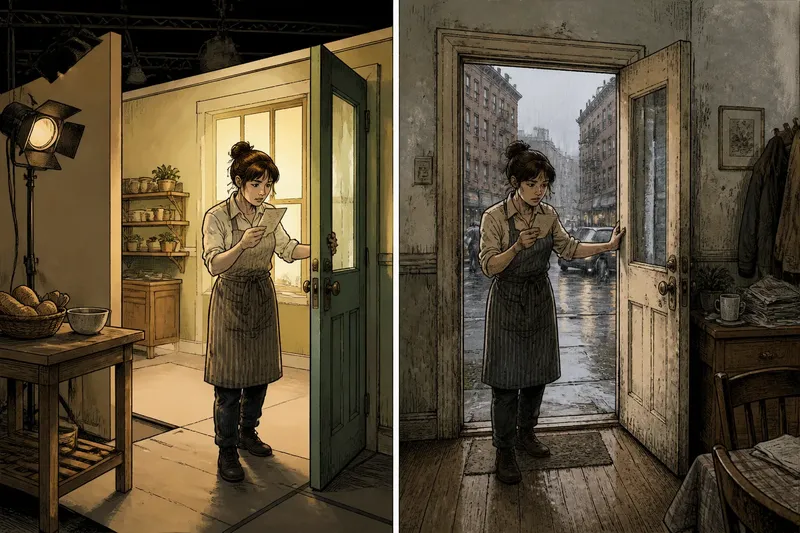
A door sticks in its frame while rain taps the glass. In a built set, that stubborn door can open on cue, and the rain can arrive exactly when the scene needs it. On location, the same moment might carry the scuffed threshold, uneven light, and distant traffic of a real place. Set versus location shooting is not simply studio polish against documentary grit; it is a choice about which details should shape the story.
A set makes the world answer to the scene
A film set is a constructed or adapted space designed for filming. It may be a complete room inside a soundstage, a single wall and doorway, or a practical location dressed and altered to serve as another place. The defining advantage is control: the production can arrange the space around the scene rather than fit the scene around every condition the space imposes.
That control can be visual. A set designer can choose the ceiling height, window placement, wall color, and what lies beyond a doorway. A cinematographer can shape light without waiting for clouds to move or neighboring signs to dim. Sound crews can work with fewer competing noises. If a character must cross the room repeatedly, the route can be kept clear and consistent.
Control is especially valuable when the story asks for a place that does not exist as a ready-made location. A cramped spacecraft, a corridor with no visible end, or a kitchen that feels subtly too symmetrical can be built to carry an idea. The room itself becomes part of the film’s argument. A polished lobby may suggest that a character is trapped by appearances; an impossible hallway can make uncertainty feel physical.
Built environments also let filmmakers manage what the camera sees. A wall can be removed for a camera move, then restored for another angle. A window can offer a painted view, a projection, or a controlled lighting effect. These choices can make a space feel larger, smaller, safer, or more exposed than its footprint suggests.
But a set’s precision can become a limitation. When every object is selected and placed, a room may feel too legible, as if it has no life beyond the scene. A chipped mug, a faded notice, or a patched curtain can help, but the details need a convincing relationship to the people who use the room. Decoration without history looks like decoration.
A real location carries details no set has to invent
Location shooting uses an existing place: an apartment, station, field, shop, or street. Its surfaces arrive with wear and irregularity. Paint may have faded unevenly; a doorway may sit awkwardly in the frame; light may bounce off a neighboring building in a way no one planned. Such details can make a fictional place feel as if it existed before the camera arrived.
That texture can do quiet storytelling. A narrow stairwell communicates pressure before anyone says they feel confined. A busy café can make a private conversation feel vulnerable. A room with mismatched repairs may suggest a household that adapts rather than replaces. The location offers evidence of use, and the film can let viewers read it without pausing to explain it.
Real places also connect a scene to a wider environment. A character can step from a doorway into an actual street, carrying the sounds, weather, and scale of that neighborhood into the frame. This continuity can make travel through the story feel grounded. The world does not stop at the edge of the set because there may be no edge to hide.
The tradeoff is that a location brings conditions the production cannot fully arrange. Ambient sound, changing daylight, access, public activity, and the shape of the room all affect what can be filmed. A tight location may limit camera position. A lovely window may face the wrong direction for the scene’s intended light. The place can offer vivid material while refusing a clean fit.
That friction is not automatically a flaw. A film may want the feeling that people are moving through a world indifferent to their plans. Yet if an uncontrolled detail competes with the scene’s main idea, texture becomes distraction. The choice is not whether a real location is more authentic; it is whether its particular reality helps the viewer attend to the right things.
Choose the kind of detail the story needs
Think of a set as a tailored coat and a location as a coat found in a busy closet. The tailored one fits a specific movement and silhouette. The found one comes with signs of whoever wore it before. Neither is inherently more expressive; each gives the filmmaker a different relationship between intention and surprise.
A set tends to suit scenes where spatial design, repeated action, or tightly shaped light carries meaning. It can support a sequence that returns to the same room under changing emotional conditions, because the production can preserve the layout while altering selected elements. It can also help when a fictional place needs to feel coherent across several angles or scenes.
A location tends to suit stories that benefit from social and physical context. A real laundromat, for instance, contains machines, waiting space, signs, and the ordinary logic of people sharing a room. Those features can give a scene a lived-in rhythm, especially when the characters’ behavior depends on the setting rather than merely taking place inside it.
Some productions combine the two. They may film exterior streets on location and build an interior that matches a visible doorway. A real house can supply its facade and yard, while a stage set provides the room needed for camera access or controlled lighting. The hybrid approach can preserve a sense of place while allowing the most important interior action to be shaped precisely.
Imagine a film about a baker who receives a difficult message during a morning shift. If the scene depends on the bakery’s actual bustle—the bell over the door, trays moving, customers waiting—a real shop could supply details that make the interruption feel embedded in work. If the message must trigger a carefully timed transformation of the room’s light and layout, a set could make that shift legible. A hybrid might use a real storefront outside and a purpose-built counter area inside. The useful question is what the viewer should notice when the message arrives.
How do sets and locations change a scene?
Does a real location always feel more authentic?
No. Authenticity comes from the fit between a place and the story’s people, habits, and visual language. A carefully designed set can feel convincing, while a real room can feel wrong if its details pull attention away from the characters.
When does a built set help most?
A set helps when the scene needs a specific layout, repeatable conditions, or an environment that cannot be found intact. It is also useful when walls, windows, or sightlines must serve a precise camera position or visual effect.
Why shoot on location if control is harder?
A location can provide accumulated wear, surrounding context, and incidental detail that would take effort to recreate. Those qualities can make a fictional scene feel connected to a broader human environment, even when the production must adapt to the place.
Can a film mix sets and real locations?
Yes. Productions often use an exterior on location and a constructed interior, or film selected rooms in a real building while building others. Matching color, architecture, and the direction of visible light helps the spaces feel like parts of one place.
Make the choice by tracing attention
A practical way to compare options is to describe what the viewer should notice in the scene, then inspect each possible space for support and interference. This is not a question of choosing the prettiest room. It is a question of whether the room’s details direct attention toward the story or scatter it.
- Identify the scene’s dominant detail. Decide whether the audience should register a doorway, a crowded counter, a long empty wall, or the signs of repeated use.
- Check the needed camera space. Consider whether the camera must pass through walls, hold a wide view, or return to the same angle without the room changing.
- Notice the location’s existing texture. Look for wear, objects, light, and background activity that add meaning, then mark anything that competes with the scene.
- Consider how the space must change. If the room’s appearance or lighting shifts as part of the storytelling, ask whether that change can be controlled in the real place.
- Compare the sound environment. Listen for traffic, ventilation, neighboring activity, and room echo that may support the scene or obscure its dialogue and silence.
- Choose a hybrid when the needs divide. Keep the location’s strongest sense of place while building or adapting only the area that requires greater control.
For a particular production, permissions, access, technical demands, and local rules can affect which option is workable; confirm those details with the relevant professionals and authorities. The creative comparison still begins with the frame: what belongs in it, what should remain outside it, and which parts of the environment need to behave consistently?
Set versus location shooting becomes easier to judge once the room is treated as an active part of the scene, not a neutral container. A set gives the filmmaker a place that can be tuned to the action. A location lends the action a place with its own accumulated character. The best choice is the one that makes the right details feel inevitable—and leaves the rest quiet enough for the story to speak.