The Scene's Quiet Compass: How Blocking Guides Your Eye
Learn how blocking guides your eye through a scene, using actor positions, movement, and stillness to reveal relationships without dialogue or camera moves.
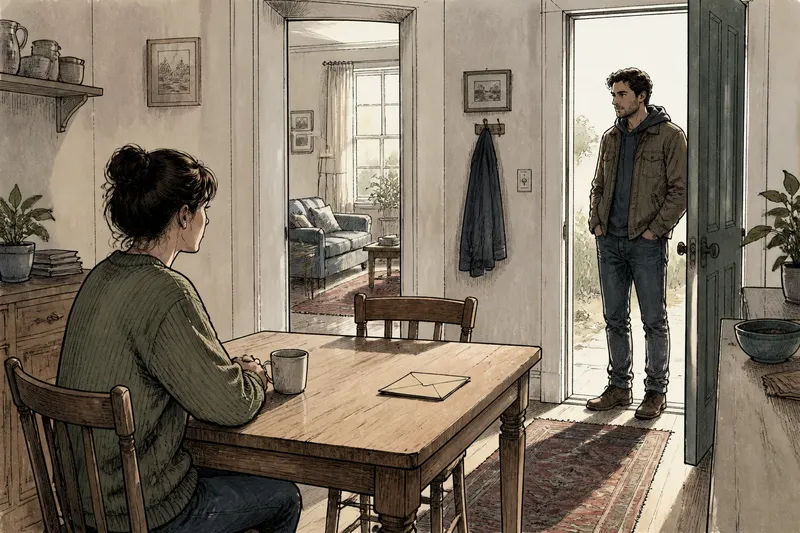
A character stops beside the doorway while another stays seated at the table. Before either speaks, the gap between them has become part of the scene. Blocking—the placement and movement of performers—can guide your eye through that relationship without a line of dialogue or a moving camera.
Watch a scene once for what is said, then again for where each person stands, sits, or turns. These small choices form a quiet visual compass: they help you notice who has room, who is waiting, and what changes when someone moves.
Blocking makes relationships visible
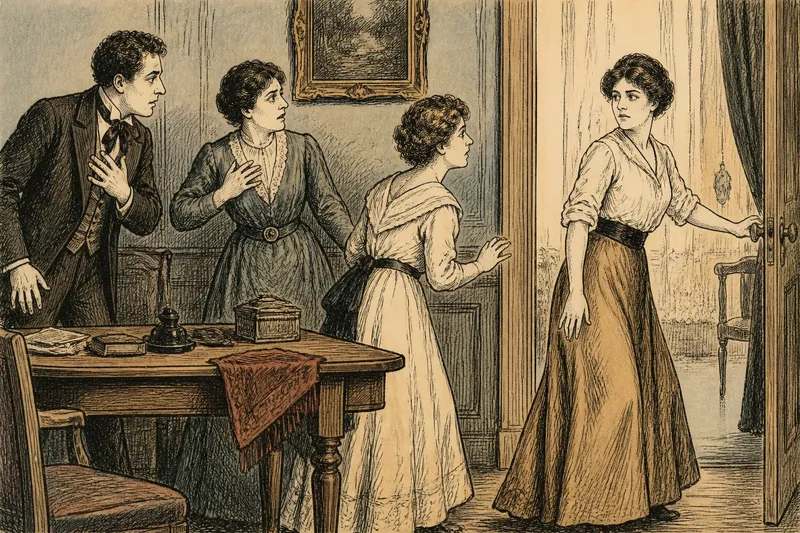
Actors share a frame, but they do not have to share its space equally. One may occupy the center while another is pushed toward an edge. One may face a partner directly; the other may angle away. Those arrangements create visual relationships before the script names them.
Distance is especially legible. A small gap can suggest comfort or routine, while a sudden retreat can make that same gap feel charged. Neither meaning is automatic. Look at the characters’ expressions, the setting, and what they do next before deciding what the spacing implies.
Height also matters. A character standing over a seated one can seem to command the exchange, but the seated character might hold the only object everyone wants. Blocking invites an interpretation; the rest of the scene refines it.
Stillness can point more sharply than movement
A moving performer naturally attracts attention. So can a performer who remains still while everyone else shifts around them. The still figure becomes a visual anchor, much like a bookend holding a row of leaning books in place.
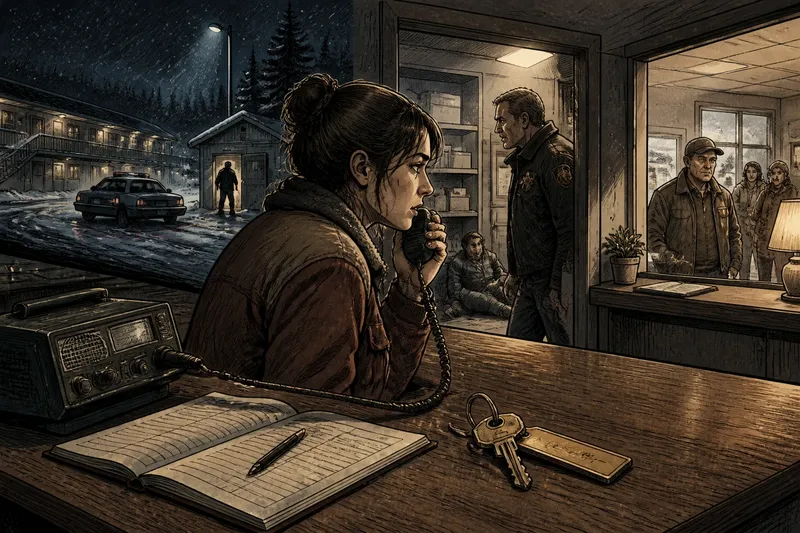
Notice where the scene places that anchor. A quiet character in the middle of a busy room may seem protected, isolated, or difficult to approach. If other performers keep turning toward them, their stillness can become the scene’s center of gravity even when they have no dialogue.
Try tracking the least active person in a crowded exchange. Do others leave them a clear path, block them, or keep checking their face? Their position may reveal what the group is organizing itself around.
Movement creates a path for attention
When a performer crosses a room, the eye follows. The route matters: a direct approach feels different from a wide arc, and stopping halfway can give a destination more weight than reaching it would. A movement can also connect two parts of the frame, drawing attention from one person or object to another.
Imagine a scene with a sibling at a kitchen table and a sealed envelope on a counter. The sibling stands, walks toward the envelope, then pauses beside it without touching it. That invented movement gives the envelope importance while the pause suggests reluctance; a viewer can register both without hearing an explanation.
Pay attention to what movement interrupts. If a character crosses between two people, they briefly divide the pair. If someone leaves a shared space, the remaining characters’ new arrangement can feel different even though no furniture has moved.
The frame’s edges and openings shape the choice
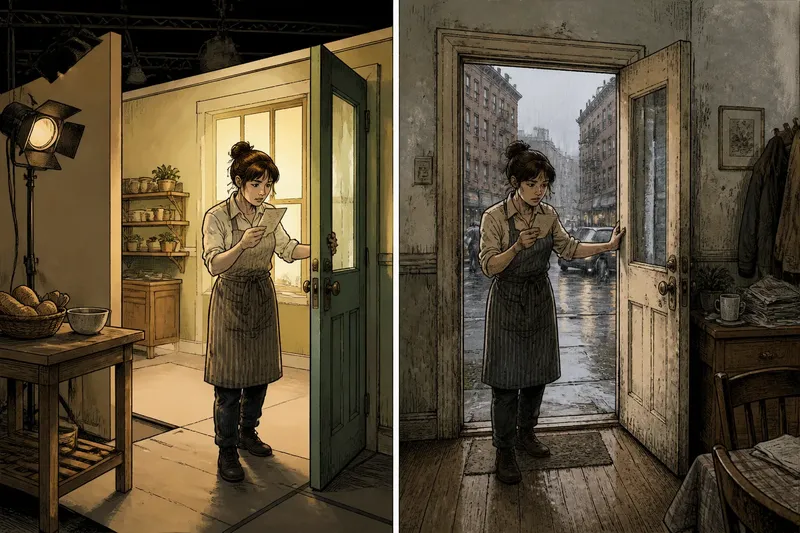
Blocking works inside the space the camera shows. A doorway can divide a character from a group; a chair can turn a direct approach into a detour. The frame’s edges matter, too: leaving a person close to the border may make them seem peripheral, or suggest they are ready to leave.
Look for sightlines: where a performer’s face and body point, and what lies along that direction. A turned head can lead your attention toward a partner, a window, or an object. If the expected target is absent, the empty space itself may become noticeable.
These cues are strongest when several agree. A person near the edge, angled toward an open door, may seem poised to go; the same placement paired with a fixed gaze toward the group can suggest they are choosing to stay outside the conversation.
What should you watch for in a scene?
Who owns the center of the frame?
Notice who occupies the most visually prominent space, then ask whether others orient toward or away from them. The answer can reveal influence, attention, or an imbalance the dialogue leaves unstated.
What changes when someone moves?
Track the arrangement before and after a performer crosses, sits, or leaves. A shift in who faces whom can alter the scene’s social geometry without changing the camera position.
Which character stays still?
Compare the still performer with those who move around them. Their quietness may make them a point of focus, but the scene’s context determines whether that reads as control, withdrawal, or simple observation.
What does the empty space invite you to notice?
Look at the gap between people, the space beside an open door, or the unoccupied chair. Ask who could cross it and what seems to prevent them; the answer can clarify the tension without turning a visual clue into a fixed rule.
Read the arrangement, not a single gesture
A useful viewing habit is to notice three things in sequence: the initial positions, the movement that changes them, and the new arrangement afterward. This is not a formula for decoding every scene. It is a way to catch how actors’ bodies direct attention while your focus is also drawn to words, faces, and props.
Return to the table and doorway. If the standing character finally sits beside the other, the reduced distance may mark a change in their relationship. If they stay by the door, the threshold remains part of the exchange. Either way, blocking gives the viewer a concrete detail to follow: where the characters place themselves, and whether they choose to move closer.
That is the scene’s quiet compass. For a clearer reading of how blocking guides your eye, follow the space between performers as carefully as their faces; it often shows which relationship is changing before anyone says so.