The Twist Ending Myth: Surprise Is Not the Whole Story
The twist ending myth confuses shock with satisfaction. See how setup, character choices, and consequences turn a surprise into an ending that feels earned.
Imagine leaving a small-town theater after a thriller’s final reveal, still turning one detail over in your mind: the helpful neighbor was the thief. The audience gasped, but the walk to the parking lot feels oddly flat. That gap is the twist ending myth in miniature: a surprise can change what a story means without making its ending satisfying.
To see why, follow an invented film from its first scene to its closing image. The point is not to remove the surprise. It is to give the surprise a history, a human cost, and a consequence the story can live with.
The reveal changes the facts but not yet the feeling
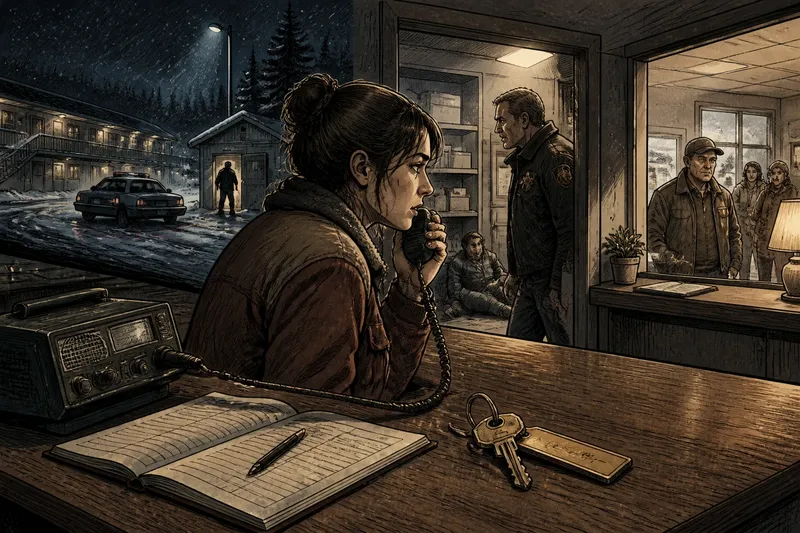
Suppose a fictional thriller, The Winter Ledger, follows Mara, a night clerk at a rural motel. After a guest disappears during a snowstorm, she helps deputy Ellis search the property. The film plants a small oddity: Ellis knows the service corridor is unlocked, though Mara has not mentioned it. On first viewing, the detail barely registers.
Near the end, the story reveals that Ellis arranged the disappearance to conceal his role in a local theft. He has used his badge to steer the search away from the motel’s storage room. The detail about the corridor now points backward and changes the audience’s reading of earlier scenes. That is a clean reversal of information.
But information alone is not an ending. If the film cuts to black as soon as Ellis is exposed, viewers may have solved a puzzle without seeing what the solution means for Mara. The reveal answers “Who did it?” It has not yet answered “What does this cost?” or “What will the central character do now?”
Earlier details need to support two readings
A satisfying twist often makes earlier scenes feel newly legible. The clue should be visible enough to recognize in retrospect, yet ordinary enough not to announce the answer. The corridor detail works because it has a practical explanation at first: Ellis is a deputy who knows the building. After the reveal, the same knowledge takes on a darker meaning.
This double reading is different from hiding the necessary information. If Ellis turns out to be Mara’s long-lost brother, but the film has offered no hint of their connection, the audience may feel that a new fact was dropped in rather than discovered. Surprise is still possible, but the story has not given the viewer much to reconsider.
Nor does every clue need to be a tiny prop or suspicious line. A character’s habit, a repeated choice, or an omission can carry the setup. What matters is that the reveal grows from the film’s existing material instead of borrowing its force from a rule introduced at the last moment.
Mara’s decision gives the twist a human shape
Now imagine the invented film continues after Ellis’s exposure. Mara finds him in the storage room with the missing guest, who is alive but injured. Ellis tells her that reporting him will ruin his family and insists he can explain. The reveal has moved the danger from an abstract mystery into a choice Mara must make.
Earlier, Mara has avoided conflict by letting other people decide what is “best” for her. She stayed silent when the motel owner withheld a guest’s belongings, and she accepted Ellis’s directions without asking why. At the climax, she can keep following that familiar pattern, or she can use the motel’s radio to call for help, making her own account of events impossible to ignore.
Suppose she calls. That choice does not need to transform her into a fearless hero. She can still be frightened; her hand can shake as she gives the address. The important change is that the story’s central person now acts on what the reveal has made clear. The twist matters because it presses on Mara’s established weakness and forces a decision, not because it simply identifies a hidden villain.
Character setup also protects a twist from feeling like a trick played on the audience. A viewer may accept that Ellis lied if the film has shown how his habits, motives, and access made the lie plausible. The more consequential question is what his deception asks of Mara, and whether her response belongs to the person the film has shown.
The consequences complete the ending
After Mara calls for help, the fictional story still has choices to make. It might end with Ellis taken away and the motel owner offering Mara a quiet apology. That would settle the immediate danger, but it could leave the emotional conflict untouched if Mara simply returns to her old routine.
Instead, picture a final scene in which Mara gives a statement in the lobby while the morning shift waits to begin. She corrects one detail in the owner’s account, then puts the motel’s spare keys on the desk and leaves. The image does not explain her whole future. It shows a visible consequence: she has stopped helping others smooth over the truth, and the place that shaped her silence no longer feels like somewhere she must stay.
Consequences do not have to mean punishment or a tidy moral. Ellis might face legal scrutiny; Mara might lose a job she needed; the missing guest might still have a long recovery. A film can leave those outcomes unresolved while still giving the central choice weight. The audience needs to feel that the reveal has altered the characters’ situation, not just its description.
Here the ending works like a door key: the twist opens a room the viewer did not know was there, but the characters still have to decide whether to enter and what to do inside. If the film reveals the hidden room and stops, the key has done its job, but the story has not finished using it.
Why can a fair twist still feel disappointing?
Can viewers guess a twist and still enjoy the ending?
Yes. If viewers anticipate Ellis’s betrayal, they can still care about what Mara chooses once she knows. Suspense may shift from “Who is responsible?” to “Will she speak up?” without draining the ending of force.
Does a twist need clues in every earlier scene?
No. A few meaningful details can support a retrospective reading without turning the film into a scavenger hunt. Excessive clues may make the answer feel announced rather than surprising.
Can a twist work if the audience never saw it coming?
It can, if the new information fits the story’s established world and gives the characters a consequential problem. If the reveal depends on facts the film could not have reasonably conveyed, surprise may arrive without a satisfying sense of recognition.
What if the twist is more important than the character?
A deliberately puzzle-driven film can make the mechanics of a revelation its main pleasure. Even then, the ending benefits from showing what the answer changes: a relationship, a goal, or the meaning of an earlier choice.
The reveal should leave the story with something to do
In this invented walk-through, Ellis’s secret is not the whole ending. The corridor clue gives it roots, Mara’s decision gives it a personal stake, and the lobby scene shows a consequence. Remove any one of those links and the reveal still exists, but it may feel less complete.
That is the useful test for a twist ending: after the surprise lands, ask what the characters must now face that they could not face in quite the same way before. The answer need not settle every mystery. It should give the final moments a changed relationship, an irreversible choice, or a new cost to carry. That is how a twist becomes more than a gasp.